
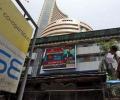
Among the Sensex constituents, as many as 16 stocks closed with losses with Nestle India, Kotak Mahindra Bank, IndusInd Bank, Bajaj Finserve, Titan and JSW Steel being the major laggards. Index major Reliance, Hindustan Unilever, Maruti and Tata Steel also declined due to selling pressure. In contrast, NTPC, TCS, Tech Mahindra, Bajaj Finance bucked the trend and ended the day in green. Axis Bank, Bharti Airtel, Mahindra & Mahindra and Tata Motors also defied the trend.

Equity benchmarks nosedived on Friday, with the Sensex crashing 866.65 points to close below the 55,000-mark amid a sell-off in global markets. Unabated foreign fund outflows and firm crude oil prices also weighed on sentiment. The 30-share BSE Sensex dived 866.65 points or 1.56 per cent to finish at 54,835.58.

Exuding confidence that current account deficit (CAD) will come down to 3.7 per cent of GDP in 2012-13, Finance Minister P Chidambaram on Monday said overseas capital flows would be sufficient to bridge the gap in inflow and outflow of foreign funds.

New investors should gradually build a 5 to 10 per cent allocation to gold.

DIIs owned equities worth Rs 73.5 trillion, just 1.9 per cent less than FPIs. This marks a significant change from a decade ago.

'It is imprudent on the part of Indian insurance companies to invest out of the shareholders' fund in a private limited company.'

Investors globally pulled out more than $3 billion from equity funds focused on Emerging markets including India in a week amid concerns over the US Federal Reserve's plan of curtailing its stimulus drive starting later this year.

From the 30-share Sensex pack, 23 scrips declined in Wednesday's session, led by IndusInd Bank, Bajaj Finance, Tata Motors and Tata Steel which fell by up to 3.87 per cent.
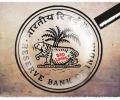
The Reserve Bank on Monday said asset quality of banks improved further and their gross non-performing assets (GNPA) or bad loans ratio declined to a 12-year low of 2.6 per cent in September 2024 on the back of falling slippages and steady credit demand. The RBI also flagged concern over a sharp rise in write-offs, especially among private sector banks (PVBs), which could be partly masking worsening asset quality in unsecured lending segment and dilution in underwriting standards.

Equity benchmark index Sensex buckled under selling pressure for the second straight session to close below the 65k mark on Friday, as investors offloaded IT, teck and metal stocks amid a bearish global trend. Besides, fresh foreign fund outflows also hit investor sentiments, traders said. In a volatile trade, the 30-share BSE Sensex declined 202.36 points or 0.31 per cent to settle at 64,948.66.

Investor wealth worth over Rs 13.44 lakh crore was wiped off on Thursday as the domestic equity markets tumbled along with global risk assets, after Russia launched military operations against Ukraine. Amid intensifying rout in the global financial markets, the 30-share BSE Sensex plummeted 2,702.15 points or 4.72 per cent to end at 54,529.91. The carnage on Dalal Street eroded investor wealth worth Rs 13,44,488.54 crore, taking the total market capitalisation (m-cap) to Rs 2,42,24,179.79 crore on the BSE.

Equity mutual funds witnessed an inflow of Rs 35,943 crore in November, marking a drop of 14 per cent on a month-on-month basis, amid heightened volatility in stock markets driven by various macroeconomic factors, geopolitical events and US election results. Despite this, it marked the 45th consecutive month of net inflows into equity-oriented funds, reflecting the growing popularity of mutual funds among investors, according to data from the Association of Mutual Funds in India (AMFI) released on Tuesday.

Investors' wealth has tumbled by over Rs 5.82 lakh crore in three days of market decline. Feeble global cues, foreign fund outflows and concerns over policy tightening by central banks have led to the selling pressure, experts said. Declining for the third straight session on Monday, the 30-share BSE benchmark Sensex nosedived 1,023.63 points or 1.75 per cent to close at 57,621.19. In three days, the benchmark has tanked 1,937.14 points.

Nine of the top-10 most valued companies together lost a whopping Rs 309,178.44 crore in market valuation last week as selloffs continued. In a holiday-shortened past week, the 30-share BSE Sensex plummeted 1,836.95 points or 3.11 per cent amid geopolitical tensions, global sell-off triggered by a hawkish US Federal Reserve and unabated foreign fund outflows. From the top-10 list, State Bank of India was the lone gainer as its valuation jumped Rs 18,340.07 crore to reach Rs 467,069.54 crore.

The broader NSE Nifty, after slipping below the 10,500-mark to hit a low of 10,477, finally concluded 29 points, or 0.27 per cent, down at 10,524.

Surplus liquidity in the banking system as measured by absorption of excess funds by the Reserve Bank of India (RBI) fell sharply at the end of the last week due to outflows on account of advance tax payments. According to the RBI data, the net liquidity absorbed by the central bank on September 16 was at Rs 3,243.57 crore, much lower than the average of Rs 56,809.92 crore in the preceding four days of the week. The average absorption of funds by the RBI so far in September is at Rs 1.13 trillion, against the average of Rs 1.2 trillion in the previous month, the data showed.

'The problem is that the bubble may not only be in valuations, but also in investors' minds.'

Titan was the top loser in the Sensex pack, shedding over 3 per cent, followed by M&M, HUL, Maruti, Asian Paints and IndusInd Bank. Nifty fell 91 points to 17,157.40.

'Expect India to keep doing well irrespective of geopolitics.'

The 50-stock NSE barometer Nifty finished 14.75 points, or 0.14 per cent, down at 10,382.70 after shuttling between 10,340.65 and 10,393.15.

Credit card payments for foreign travel will be brought under the purview of the Liberalised Remittance Scheme (LRS) of the Reserve Bank, to ensure that such expenses do not escape TCS (Tax Collection at Source). While moving the Finance Bill 2023 for consideration and passage in the Lok Sabha on Friday, Finance Minister Nirmala Sitharaman said the Reserve Bank has been asked to look into ways to bring credit card payments on foreign tours under the LRS. "It has been represented that payments for foreign tours through a credit card are not being captured under the Liberalised Remittance Scheme (LRS) and such payments escape tax collection at source (TCS)," she said.

The rupee depreciated 6 paise to 77.50 against the US dollar in the opening trade on Wednesday as a surging American currency in the overseas markets and persistent foreign fund outflows weighed on investor sentiment. Besides, rising global crude prices impacted the domestic unit, forex traders said. However, a higher opening in the domestic equity market restricted the rupee's fall, they added.

On the BSE, 2,243 scrips declined, while 224 advanced and 106 remained unchanged.

From the Sensex pack, State Bank of India, ICICI Bank, IndusInd Bank, Axis Bank, Kotak Mahindra Bank, HDFC Bank, Reliance Industries were among the major laggards. Bucking the trend, auto stocks Tata Motors and Mahindra & Mahindra closed with gains.

Equity indices nursed losses for the second consecutive session on Tuesday as investors continued to dump IT, banking and FMCG stocks amid a bearish trend in global markets. Unabated foreign fund outflows and the rupee dropping to another record low against the US dollar added to the woes, traders said. Participants were also in wait-and watch mode ahead of release of retail inflation and factory output data.

'Binary fission will happen -- startups will lead to more startups.'

The 50-scrip NSE barometer Nifty declined 43.80 points, or 0.41 per cent, to close at 10,570.55

Benchmark indices ended on a flat note on Thursday as fag-end selling wiped out intra-day gains amid weak global trends. The BSE benchmark Sensex slipped 8.03 points or 0.02 per cent to settle at 53,018.94. During the day, it had gained 350.57 points or 0.66 per cent to 53,377.54. Similarly, the broader NSE Nifty fell 18.85 points or 0.12 per cent to close at 15,780.25.

HDFC and HDFC Bank were the biggest losers in the Sensex pack, plunging 5.09 per cent and 3.32 per cent, respectively, after the private bank reported a rise in non-performing assets.

Foreign portfolio investors (FPIs) have net sold domestic shares worth over $10 billion so far this month amid a shift to China, which not only offers attractive valuations compared to India but has also announced several measures to support the economy and the stock market in recent weeks. If the trend doesn't reverse, this will be the first time that overseas funds will yank out more than $10 billion from Indian equity markets in a month.

Among the Sensex constituents, Tata Motors was the biggest loser with 6.52 per cent fall, followed by Vedanta 5.09 per cent, Bajaj Auto 4.99 per cent, Maruti Suzuki 4.26 per cent and Tata Steel 2.65 per cent.

Kotak Bank was the top loser in the Sensex pack, falling over 4 per cent, followed by IndusInd Bank, Axis Bank, ONGC, HDFC Bank, Bajaj Auto and Reliance Industries.

A declining rupee, elevated crude oil prices and sustained foreign fund outflows added to the gloom
Investors became poorer by over Rs 4.47 lakh crore on Friday as markets faced severe drubbing, mirroring weak trends in global equities. The 30-share BSE benchmark dived 866.65 points or 1.56 per cent to settle at 54,835.58. During the day, it tumbled 1,115.48 points or 2 per cent to 54,586.75.
M&M was the top gainer in the Sensex pack, rallying around 7 per cent, followed by Bajaj Finance, Hero MotoCorp, RIL, Titan and Bajaj Auto. On the other hand, ONGC, Tech Mahindra, PowerGrid, Infosys and Kotak Bank were among the laggards.
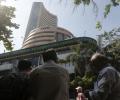
A rally in Reliance Industries and Kotak Bank helped the index recover some of the losses

Powered by a rally in index heavyweight Reliance Industries, equity benchmark Sensex broke its four-session losing run to close above the 55,000-mark on Thursday despite a weak trend overseas. Investors made a cautious return to IT, pharma and bank stocks after their recent sell-off. However, a depreciating rupee and persistent foreign fund outflows capped the gains, traders said. Overcoming a lacklustre start, the 30-share BSE Sensex surged 427.79 points or 0.78 per cent to close at 55,320.28.

Foreign investors continued their relentless selling in the Indian equity markets in August, offloading shares worth Rs 21,201 crore due to the unwinding of the yen carry trade, recession fears in the US and ongoing geopolitical conflicts. This came after an inflow of Rs 32,365 crore in July and Rs 26,565 crore in June, data with the depositories showed.

The NSE Nifty reclaimed the 9,800 mark
